


Custom Battery Charger Development Process: From Prototype to Mass Production
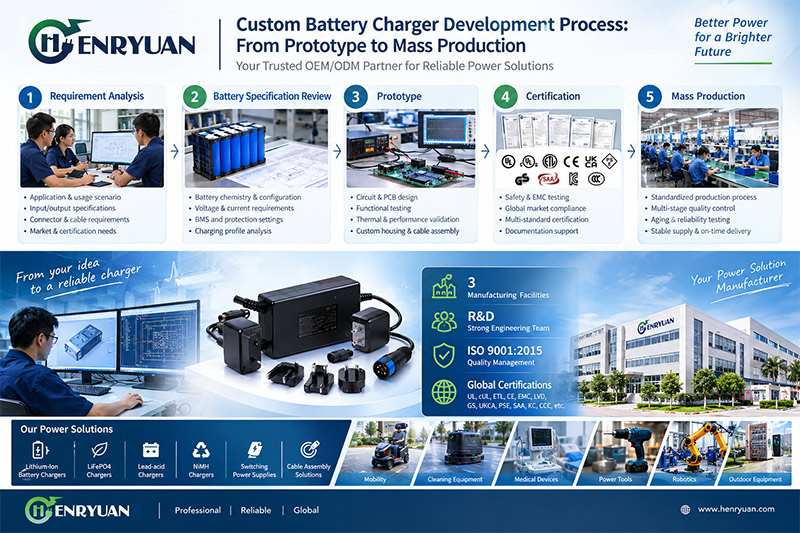
Custom Battery Charger Development Process: From Prototype to Mass Production
For an OEM product, a battery charger is rarely just another accessory. It is part of the product's power architecture—and a charger that is poorly matched to the battery can affect charging time, thermal performance, battery life, safety, regulatory compliance, and the user's overall experience.
That is why developing a custom charger requires more than changing the output voltage or current on an existing model.
A reliable charger needs to be engineered around the battery, the end product, the operating environment, and the target market. At Henryuan, we approach custom charger development as a structured engineering process that connects requirements analysis, battery evaluation, prototype development, compliance testing, and controlled mass production.
The goal is not simply to produce a working sample. The goal is to turn a validated engineering solution into a stable, repeatable product that can support an OEM program at scale.
The Henryuan Custom Charger Development Process
Requirement Analysis
↓
Battery Specification Review
↓
Prototype
↓
Certification
↓
Mass Production
Each stage has a specific purpose. More importantly, decisions made in the early stages can significantly influence the performance and manufacturability of the final product.
1. Requirement Analysis
Every successful charger project starts with a clear understanding of what the charger actually needs to do.
An OEM customer may provide a basic requirement such as:
"We need a 42V 5A charger for our battery pack."
That specification is a starting point—not a complete engineering definition.
Before selecting a charging architecture, Henryuan engineers evaluate the broader application requirements, including:
-
Battery chemistry
-
Nominal battery voltage
-
Maximum charging voltage
-
Required charging current
-
Expected charging time
-
Input voltage and frequency
-
Operating temperature
-
Storage conditions
-
Charger dimensions
-
DC connector
-
Cable length and gauge
-
Plug configuration
-
Enclosure requirements
-
Protection requirements
-
Target sales markets
-
Applicable safety and EMC standards
The application itself is equally important.
A charger designed for a robotic cleaning machine may have very different requirements from one used with a portable medical device, electric mobility product, industrial instrument, or professional battery-powered system.
This is where an experienced OEM battery charger manufacturer can make a meaningful difference.
Rather than treating the customer's specification as a fixed list of numbers, the engineering team looks at how those parameters interact within the finished product.
Why the first stage matters
Many problems discovered during certification or mass production can actually be traced back to decisions made much earlier in development.
For example, insufficient thermal margin, an unsuitable connector, inadequate cable sizing, or an incorrect charging profile can become expensive to correct once tooling, certification, and production have already begun.
Early engineering review helps identify those risks before they become production problems.
2. Battery Specification Review
The charger and battery must be treated as a system.
This is particularly important with lithium-ion and LiFePO4 batteries, where the charging voltage must correspond correctly to the battery configuration and chemistry.
For example, a 4S lithium-ion battery pack typically has a nominal voltage of 14.8V and requires a charging voltage of 16.8V.
That is why Henryuan's product portfolio includes different charger platforms such as 8.4V, 12.6V, 16.8V, 25.2V, 29.4V, 42V, 50.4V, 54.6V, 58.8V and 67.2V, among other configurations.
But voltage matching is only part of the review.
Henryuan engineers may also need to understand:
-
Battery capacity
-
Cell configuration
-
BMS characteristics
-
Maximum permitted charging current
-
Battery manufacturer's charging requirements
-
Charge termination conditions
-
Protection behavior
-
Connector polarity
-
Communication requirements, where applicable
For OEM projects, battery specifications should ideally come from the actual battery or battery-pack manufacturer rather than being estimated from nominal voltage alone.
This allows the charger design to be based on the real electrical characteristics of the system.
3. Prototype Development
Once the electrical and application requirements are established, the project moves into prototype development.
This stage is where engineering assumptions meet physical hardware.
Henryuan can develop charger samples around the agreed specifications, including customized:
-
Output voltage
-
Charging current
-
DC connector
-
Cable assembly
-
Plug configuration
-
Housing
-
Labeling
-
Packaging
Prototype evaluation typically goes beyond simply checking whether the charger produces the correct output.
Engineers need to verify the behavior of the complete charging system.
Depending on the application, testing may include:
-
Output voltage accuracy
-
Charging current stability
-
CC/CV charging behavior
-
No-load performance
-
Full-load performance
-
Short-circuit protection
-
Over-current protection
-
Over-voltage protection
-
Thermal performance
-
Insulation and dielectric strength
-
EMC performance
-
Abnormal operating conditions
For lithium battery applications, the charging profile is particularly important.
A typical lithium-ion charging process uses constant-current (CC) charging followed by constant-voltage (CV) charging, with the current gradually decreasing as the battery approaches its full-charge voltage.
The charger therefore needs to maintain appropriate voltage and current behavior throughout the charging cycle—not simply deliver a fixed DC output.
4. Certification
For products entering international markets, certification cannot be treated as a final administrative step.
It needs to be considered during engineering.
Henryuan has experience supporting products intended for markets with requirements associated with certifications and standards including:
UL, cUL, ETL, CE, EMC, LVD, GS, UKCA, PSE, SAA, KC, CCC, and other applicable requirements.
Different markets can introduce different requirements related to:
-
Electrical safety
-
EMC
-
Insulation
-
Leakage current
-
Creepage and clearance
-
Component requirements
-
Temperature rise
-
Mechanical construction
-
Energy efficiency
-
Plug and cord configuration
A charger that works perfectly in a laboratory may still require design changes before it can successfully pass the requirements for a specific market.
That is why certification planning should begin before the final design is frozen.
The engineering team can consider the intended certification path when selecting components, designing the PCB, determining insulation structures, choosing the enclosure, and configuring the input and output connections.
This approach can reduce the risk of late-stage redesign and help OEM customers move more efficiently toward commercialization.
5. Mass Production
A successful prototype is only one milestone.
For an OEM customer, the real challenge begins when the project moves from dozens of samples to hundreds, thousands, or ongoing production.
This is where manufacturing capability becomes critical.
Henryuan operates three manufacturing facilities, supported by dedicated R&D and engineering capabilities, production resources, quality management, and testing processes.
The company is also ISO 9001:2015 certified, providing a structured framework for quality management and continuous process improvement.
During production, quality cannot depend solely on final inspection.
A reliable manufacturing process needs control points throughout the production cycle, including:
Incoming Material Control
↓
Production Process Control
↓
Electrical Testing
↓
Safety Testing
↓
Aging / Reliability Testing
↓
Final Inspection
↓
Packaging & Shipment
This approach helps identify potential problems before they reach the customer.
For OEM programs, production consistency is particularly important. The charger supplied with the first production batch needs to behave the same way as the charger supplied months or years later.
That requires controlled specifications, qualified components, standardized production procedures, inspection criteria, and ongoing quality management.
From Engineering Sample to Repeatable Product
One of the biggest differences between a product developer and a mature manufacturing partner is the ability to bridge the gap between prototype performance and production consistency.
A prototype can prove that a concept works.
Mass production must prove that the concept can be reproduced reliably.
That transition involves much more than increasing production capacity.
It requires:
-
Controlled BOMs
-
Defined production specifications
-
Consistent component sourcing
-
Process documentation
-
Test procedures
-
Quality checkpoints
-
Production traceability
-
Engineering change control
For an OEM customer, these systems help create greater confidence when launching a new product and scaling it into long-term production.
Why Customization Matters for OEM Chargers
There is a tendency to view customization as simply putting a customer's logo on a standard charger.
In serious OEM development, customization goes much deeper.
A customer may need a specific combination of:
Battery chemistry + voltage + current + connector + cable + enclosure + plug + certification + packaging
That combination can determine whether a charger is genuinely suitable for the finished product.
Henryuan's product portfolio covers a broad range of lithium-ion, LiFePO4, lead-acid, and NiMH battery charging solutions, along with switching power supplies and cable assemblies.
This broader manufacturing capability allows the engineering team to consider the charger as part of a larger power solution rather than an isolated component.
Built for Global OEM Requirements
Henryuan was established in 2012 and has spent more than a decade developing its capabilities in power electronics manufacturing.
Today, the company combines:
-
3 manufacturing facilities
-
Dedicated R&D capabilities
-
Professional engineering teams
-
Structured production processes
-
ISO 9001:2015 quality management
-
Extensive safety and EMC certification experience
-
Battery charger manufacturing
-
Switching power supply manufacturing
-
Cable assembly capabilities
-
OEM/ODM development support
This combination is particularly relevant to international OEM customers that need a supplier capable of supporting both engineering development and ongoing production.
The objective is not to offer the largest possible product catalog.
It is to provide a dependable engineering and manufacturing platform that can adapt to the requirements of different battery-powered products.
The Best Charger Development Process Starts Before the First Prototype
A reliable custom charger is rarely the result of one brilliant engineering decision.
It is usually the result of dozens of small decisions made correctly throughout development.
Requirement analysis establishes the application.
Battery specification review establishes the electrical foundation.
Prototype development turns engineering requirements into physical hardware.
Certification validates the design against market requirements.
Mass production turns the validated design into a consistent commercial product.
At Henryuan, these stages are connected rather than treated as isolated tasks.
That is what allows a charger to move from an initial technical discussion to a production-ready solution with fewer surprises along the way.
For OEM brands developing the next generation of battery-powered equipment, the right charger manufacturer should be more than a source of finished products.
It should be a partner capable of understanding the battery, engineering the charging solution, managing production, supporting compliance, and delivering consistent quality at scale.
That is the role Henryuan continues to build toward: helping global OEM brands turn battery-charging requirements into stable, production-ready power solutions.
Explore Henryuan's Battery Charger Solutions
Lithium-Ion Battery Chargers
https://www.henryuan.com/e_products/Lithium-Ion-Battery-Charger-6.html
LiFePO4 Battery Chargers
https://www.henryuan.com/e_products/LiFePO4-Battery-Charger-7.html
Lead-Acid Batterry Charger
https://www.henryuan.com/e_products/Lead-acid-Battery-Charger-8.html
NiMH Batterry Charger
https://www.henryuan.com/e_products/NIMH-Battery-Charger-9.html
Switching Power Supply
https://www.henryuan.com/e_products/Switching-Power-Supply-10.html
Henryuan Group
https://www.henryuan.com/


 Mail inquiry