


What Certifications Should You Look For When Buying Battery Chargers?
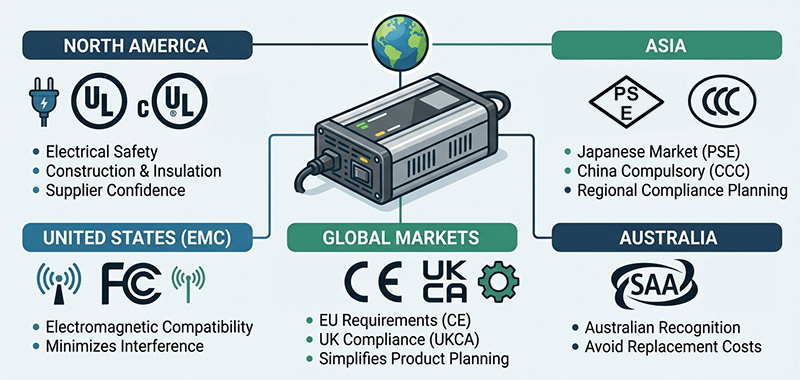
What Certifications Should You Look For When Buying Battery Chargers?
When you're buying a battery charger for an OEM product, certification shouldn't be treated as a box-checking exercise.
A charger may have the right voltage, current, connector, and price, yet still create problems when the finished product enters a new market. Electrical safety, electromagnetic compatibility, plug requirements, component selection, insulation, and regional regulations can all affect whether a charger is suitable for commercial use.
For OEM engineers and purchasing teams, the more important question is not simply “Does this charger have a certification?” but rather:
Does the charger have the right compliance credentials for the market where my product will be sold?
This is particularly important for lithium-ion, LiFePO4, lead-acid, and other rechargeable battery systems, where the charger is directly involved in the product's power and charging system.
As a China-based battery charger manufacturer with more than a decade of manufacturing experience, Henryuan has developed its product portfolio around international OEM requirements. Founded in 2012, the company operates three manufacturing subsidiaries in Shenzhen, Dongguan, and Guangzhou, with more than 11,500 m² of production space and a workforce of 462 professionals. Its quality system is certified to ISO 9001:2015, while its charger products cover applications from low-power battery packs to high-power charging systems.
Henryuan's product range includes lithium-ion, LiFePO4, lead-acid, and NiMH battery chargers, as well as switching power supplies and cable assemblies. Its lithium-ion charger portfolio covers 1S–17S battery systems, with charging outputs ranging from 4.2V to 71.4V and power ratings from 3W to 3000W.
So, what should buyers actually look for?
UL: A Key North American Safety Certification
UL is one of the most recognizable safety marks in the North American market.
For battery chargers and power supplies, UL certification is associated with electrical safety evaluation, including areas such as insulation, construction, temperature, abnormal conditions, and other applicable safety requirements.
For an OEM selling products in the United States, a charger with appropriate UL compliance can simplify product qualification and provide greater confidence during supplier evaluation.
But there's an important point:
Not every UL mark means exactly the same thing.
The applicable UL standard, certification scope, product construction, and intended application all matter.
That's why buyers should ask suppliers for the actual certification information rather than relying solely on a "UL Certified" statement on a product listing.
Henryuan's charger portfolio includes UL-certified solutions across multiple voltage and current configurations.
cUL: Designed for the Canadian Market
For products entering Canada, cUL is another important certification to understand.
cUL indicates recognition for the Canadian market and is relevant when an OEM product is being designed for sale or distribution in Canada.
For manufacturers selling into both the United States and Canada, choosing a charger with appropriate UL/cUL coverage can be more practical than developing completely separate power solutions for the two markets.
Henryuan offers charger models carrying UL/cUL certifications, depending on the specific product and configuration.
For purchasing teams, the important step is to confirm that the exact charger model—not simply the manufacturer's overall product portfolio—has the certification required for the application.
CE: Essential for the European Market
CE marking is particularly important for products placed on the European market.
Unlike UL, CE is not simply a single safety certification issued by one organization. It represents a manufacturer's declaration that the product complies with applicable European Union requirements.
For battery chargers, relevant requirements may include electrical safety and electromagnetic compatibility, depending on the product.
Henryuan specifically references CE, LVD, and EMC compliance across its charger portfolio.
For an OEM buyer, this distinction is important.
A charger being labeled "CE" does not automatically mean every European regulatory requirement has been addressed. Buyers should understand:
-
Which directives or regulations apply
-
Which standards were used
-
Whether EMC testing has been completed
-
Whether LVD requirements apply
-
What technical documentation is available
-
Whether the certification applies to the exact model
This level of documentation becomes especially important when the charger is integrated into a larger finished product.
FCC: Electromagnetic Compatibility in the United States
FCC requirements are particularly relevant to electronic products marketed in the United States.
While people often associate FCC compliance with wireless equipment, electromagnetic emissions can also be relevant to power electronics.
A poorly designed switching power supply or charger can generate unwanted electromagnetic interference that affects nearby electronics.
For OEM applications, this can become a system-level issue.
A charger might meet its electrical output specifications while still causing problems with:
-
Sensors
-
Communication interfaces
-
Displays
-
Controllers
-
Wireless modules
-
Measurement equipment
That's why EMC considerations should ideally begin during charger development rather than after the final product has been designed.
Henryuan highlights FCC and EMC capability as part of its international compliance offering and maintains in-house engineering and EMC testing capabilities to support product development.
UKCA: Compliance for the United Kingdom
For products entering the UK market, UKCA is an important regulatory consideration.
UKCA is associated with the United Kingdom's product conformity framework and should be evaluated according to the applicable product regulations and current market-entry requirements.
For global OEM brands, this becomes increasingly important when the same battery-powered product is sold across both European and UK markets.
A charger platform capable of supporting multiple regional requirements can reduce engineering duplication and simplify product planning.
Henryuan lists UKCA among its international certifications and compliance capabilities.
PSE: An Important Requirement for Japan
PSE is Japan's electrical safety framework and is particularly important for electrical products entering the Japanese market.
For battery chargers and AC-powered adapters, the applicable Japanese requirements need to be considered based on the product category and construction.
This is another example of why a charger designed for one market cannot automatically be assumed to be suitable everywhere.
Japanese market requirements can affect areas such as:
-
AC input configuration
-
Power cord and plug
-
Electrical safety
-
Marking
-
Documentation
-
Applicable testing requirements
Henryuan's product portfolio includes PSE-certified charger models for Japanese-market applications.
SAA: Supporting the Australian Market
SAA certification is widely recognized in Australia and is an important consideration for electrical equipment intended for the Australian market.
For OEM customers developing products for Australia, selecting an appropriately certified charger from the beginning can help avoid replacing the power supply later in the product-development cycle.
Henryuan's charger portfolio includes SAA-certified products, including solutions for different lithium battery configurations.
For example, Henryuan's product portfolio includes chargers combining certifications such as UL, CE, PSE, and SAA, allowing certain product platforms to address multiple international markets.
CCC: China's Compulsory Certification Framework
For products intended for the Chinese market, CCC—China Compulsory Certification—is another important regulatory consideration.
CCC is particularly relevant when products fall within China's compulsory certification catalog.
For manufacturers operating globally, understanding CCC alongside international certifications allows the engineering team to plan regional compliance more systematically.
Henryuan includes CCC among its international certification capabilities, alongside UL, cUL, ETL, CE, FCC, UKCA, PSE, SAA, KC, and other compliance credentials.
One Charger Does Not Automatically Need Every Certification
This is one of the most important points for purchasing managers.
A charger does not necessarily need UL, cUL, CE, FCC, UKCA, PSE, SAA, and CCC simultaneously.
The correct certification package depends on:
Target market + product category + electrical architecture + applicable regulations + customer requirements
For example:
| Target market | Common compliance consideration |
|---|---|
| United States | UL / FCC and applicable requirements |
| Canada | cUL / applicable Canadian requirements |
| European Union | CE / applicable EU requirements |
| United Kingdom | UKCA / applicable UK requirements |
| Japan | PSE / applicable Japanese requirements |
| Australia | SAA / applicable Australian requirements |
| China | CCC / applicable Chinese requirements |
This is why an experienced battery charger manufacturer should be involved before the final product specification is frozen.
Certification Is Only One Part of Charger Quality
A certification mark alone doesn't tell the whole story.
For an OEM customer, a reliable charger should also be evaluated for:
Electrical performance
-
Output voltage accuracy
-
Charging current stability
-
Load regulation
-
Charging efficiency
-
CC/CV behavior
Protection
-
Over-voltage protection
-
Over-current protection
-
Short-circuit protection
-
Over-temperature protection
-
Reverse-polarity protection where applicable
Henryuan's lithium-ion and LiFePO4 charger platforms incorporate multiple protection functions depending on the model.
Thermal performance
Heat management can become increasingly important as charger power rises.
A compact 3W charger and a 1000W+ charging system face completely different thermal challenges.
EMC performance
A charger must coexist with the rest of the electronics in the finished product.
Mechanical integration
Connector type, cable length, enclosure dimensions, mounting method, and AC plug configuration can all affect the final product.
Manufacturing consistency
Perhaps most importantly, the charger must perform consistently from the first production batch to long-term mass production.
Why Henryuan's Manufacturing Scale Matters
Certification capability is much more meaningful when it is supported by a mature manufacturing infrastructure.
Henryuan was established in 2012 and today operates 3 manufacturing facilities in China and more then 460 employees, and annual production value exceeding 270 million.
Its capabilities extend across:
-
Lithium-ion battery chargers
-
LiFePO4 battery chargers
-
Lead-acid battery chargers
-
NiMH battery chargers
-
Switching power supplies
-
DC-DC chargers
-
Cable assemblies
The company also supports OEM and ODM projects from engineering development through prototype validation and mass production.
This scale is particularly relevant when certification and production need to work together.
A design may pass testing, but maintaining the same electrical and mechanical characteristics during mass production requires controlled materials, documented processes, testing procedures, engineering change management, and quality control.
That is where manufacturing experience makes a difference.
Certification Should Be Considered at the Beginning—Not the End
One of the most expensive mistakes in OEM product development is leaving certification until the final stage.
Imagine a product has already completed its mechanical design, battery integration, PCB development, and tooling.
Then the charger fails an EMC test.
Or the input configuration needs to change.
Or a component isn't acceptable for the intended certification.
The resulting redesign can affect the charger, PCB, enclosure, cable, documentation, and sometimes the entire product.
A better approach is:
Market Analysis
↓
Battery & Charger Specification
↓
Applicable Certification Review
↓
Engineering Design
↓
Prototype
↓
Safety & EMC Testing
↓
Certification
↓
Mass Production
This approach allows compliance requirements to influence engineering decisions before the design becomes difficult or expensive to change.
What OEM Buyers Should Ask a Battery Charger Manufacturer
Before approving a charger supplier, purchasing and engineering teams should ask several straightforward questions:
1. Which certifications apply to this exact model?
Not just the manufacturer in general.
2. Can you provide certification documentation?
The applicable reports, certificates, or declarations should be available as appropriate.
3. Which markets is this charger designed for?
US, Canada, EU, UK, Japan, Australia, China, or multiple markets?
4. Has EMC performance been evaluated?
Especially important when the charger will be integrated into sensitive electronic equipment.
5. Can the charger be customized?
Voltage, current, connector, cable, enclosure, plug, label, and other parameters may need to match the OEM product.
6. Can the manufacturer support mass production?
A successful prototype is not enough for a long-term OEM program.
7. Can engineering support continue after certification?
Product changes, component substitutions, and future revisions may require engineering review.
Built for Global Power Requirements
For Henryuan, international certification is not simply a collection of logos on a product page.
It is part of a broader manufacturing and engineering capability designed to support OEM customers across different markets.
From UL and cUL in North America, to CE in Europe, UKCA in the UK, PSE in Japan, SAA in Australia, and CCC in China, the right compliance strategy depends on where the finished product will be sold and how the charger will be integrated.
Henryuan combines this international compliance experience with three manufacturing facilities, ISO 9001:2015 quality management, R&D capabilities, and a broad portfolio of battery chargers and power solutions.
For OEM brands, that combination means one thing:
Certification can be considered as part of the engineering process—not as an obstacle at the end of it.
A reliable charger should deliver the right voltage and current. A professional charger manufacturer should go further—understanding the battery, the application, the market, the applicable standards, and the realities of mass production.
That is the approach Henryuan continues to bring to global OEM and ODM power projects.
Explore Henryuan's Certified Battery Charger Solutions
Henryuan's official product portfolio includes power covering 4.2V to 71.4V, such as Lithium-ion, LiFePO4, lead-acid, and NiMH charging solutions.


 Mail inquiry