


How Thermal Management Improves Battery Charger Reliability and Lifespan
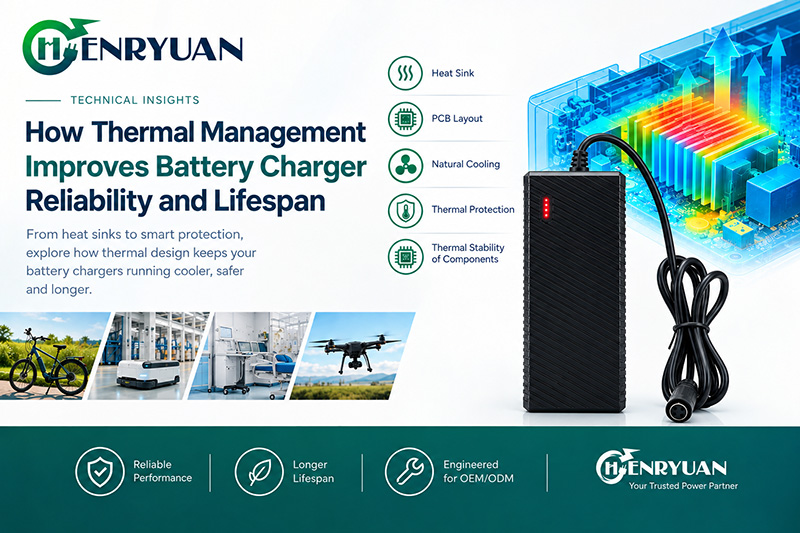
Heat is one of the least visible—and most important—factors affecting battery charger reliability.
A charger may deliver the correct voltage and current on the bench, yet still experience premature component aging, unstable operation, or reduced service life after months of continuous use. In many cases, the problem is not the charging algorithm itself. It is how effectively the charger manages the heat generated during power conversion.
For OEM equipment manufacturers, this becomes even more important as charging power increases. A compact 30W adapter and a 300W industrial charger may use similar fundamental electrical principles, but their thermal challenges are very different.
At Henryuan, thermal management is considered as part of the overall charger design rather than an afterthought. Heat dissipation, PCB layout, component selection, enclosure design, natural cooling, and protection mechanisms all influence the long-term stability of a charging system.
Why Heat Matters in Battery Charger Design
Every power converter generates some degree of heat.
The relationship is straightforward:
Power loss = Input Power − Output Power
For example, if a charger delivers 300W at 96% efficiency, approximately 12W is converted into heat.
If efficiency increases to 98%, the heat loss drops to approximately 6W.
That difference may look small on paper, but inside a compact enclosure, it can have a significant effect on component temperature.
Higher internal temperatures can accelerate the aging of electrolytic capacitors, semiconductors, transformers, insulation materials, connectors, and other components.
This is why thermal design becomes increasingly important in applications such as robotics, e-mobility, industrial equipment, floor-cleaning machines, and other systems that operate for long periods.
Henryuan's current lithium-ion battery charger portfolio covers a broad range of charging voltages and power levels, including 16.8V, 25.2V, 29.4V, 33.6V, 42V, 54.6V and other configurations.
For OEM engineers, the important question is therefore not simply:
“Can this charger provide the required output?”
A better question is:
“Can it maintain that output reliably under the actual thermal conditions of the final product?”
Heat Sink Design: Creating a Better Thermal Path
A heat sink does more than simply provide a larger metal surface.
Its real purpose is to create a low-resistance thermal path between heat-generating components and the surrounding environment.
Power semiconductors, transformers, rectifiers, and other high-loss components generate heat during operation. If that heat remains concentrated around the component, local temperature can rise significantly even when the overall charger enclosure feels relatively cool.
A properly designed thermal path helps move heat away from these hot spots.
The process can be thought of as:
Component → Thermal Interface → Heat Spreader/Heat Sink → Enclosure → Ambient Air
This is particularly important for high-power chargers where several components may generate heat simultaneously.
For example, Henryuan's 29.4V 10A lithium-ion battery charger is designed for 7S 24V-class lithium-ion battery packs, with output options ranging from 1A through 15A in this product category.
At this power level, thermal design cannot be separated from electrical performance. Component temperature, enclosure temperature, airflow, efficiency, and continuous-load operation all become part of the engineering equation.
PCB Layout Is Part of Thermal Management
Thermal performance starts before the charger is assembled.
PCB layout can determine where heat accumulates and how effectively it spreads through the board.
High-current traces need appropriate copper width and thickness. Heat-generating components should be positioned with sufficient consideration for thermal interaction. Sensitive components may need to be kept away from high-temperature areas.
There is also an important relationship between thermal design and EMC performance.
Moving a component to improve airflow may affect current paths. Changing a switching loop may improve thermal distribution but alter EMI characteristics. Increasing copper area may improve heat spreading while also changing electrical behavior.
Good charger design therefore requires engineers to consider electrical, thermal, mechanical, and EMC requirements together rather than optimizing each one independently.
This becomes particularly valuable for OEM products where the charger must eventually fit into a specific enclosure or equipment architecture.
For projects requiring more than an off-the-shelf adapter, Henryuan provides OEM and ODM battery charger development, allowing charger specifications, connectors, output parameters and other requirements to be evaluated as part of the overall product design.
Natural Cooling Can Improve Long-Term Reliability
Fans are an obvious solution to thermal problems, but they are not always the best solution.
A fan introduces moving parts, noise, dust exposure, and another potential failure point.
For many charger applications, natural convection can provide a more robust approach when the thermal design is properly engineered.
This is particularly relevant for equipment such as:
-
Autonomous mobile robots
-
Floor-cleaning machines
-
E-bikes and mobility equipment
-
Industrial devices
-
Portable equipment
-
Power tools
The objective is not simply to eliminate a fan.
The real engineering goal is to ensure that heat can move efficiently from the components into the enclosure and ultimately into the surrounding environment.
Henryuan's product portfolio includes chargers across different power levels and battery configurations, allowing thermal performance to be considered alongside output requirements rather than treating cooling as an independent issue.
Fanless operation should be the result of good thermal engineering—not simply the removal of a fan.
Thermal Protection Is the Last Line of Defense
Thermal protection is important, but it should not be used to compensate for poor thermal design.
A charger may incorporate over-temperature protection that reduces output or shuts the system down when internal temperature reaches a predefined limit.
That protects the hardware from catastrophic overheating.
However, if a charger regularly operates close to its thermal protection threshold, the system is already under unnecessary thermal stress.
A better design keeps normal operating temperatures comfortably below the protection limit.
Henryuan's lithium-ion charger range incorporates protection functions such as over-voltage, over-current, short-circuit and reverse-polarity protection, depending on the specific model.
For OEM engineers, thermal protection should therefore be viewed as a safety layer, not as the primary thermal-management strategy.
Thermal Stability of Components Matters
Not every electronic component responds to temperature in the same way.
Some components experience changes in electrical characteristics as temperature rises. Others simply age faster.
Capacitors are a classic example. Their operating temperature has a direct relationship with expected service life. Semiconductors, transformers, connectors, insulation materials, and solder joints can also be affected by repeated thermal cycling.
This means charger reliability cannot be evaluated only by asking whether the unit passes a short laboratory test.
A better evaluation considers:
-
Operating temperature
-
Continuous load
-
Peak load
-
Ambient temperature
-
Charging duration
-
Enclosure ventilation
-
Component temperature
-
Thermal cycling
-
Long-term aging
This is especially relevant for battery-powered equipment that may recharge multiple times every day.
Different Battery Systems Create Different Thermal Requirements
Thermal requirements are also influenced by the battery system itself.
A compact 16.8V charger for a 4S lithium-ion battery has very different power and thermal requirements from a 29.4V 10A charger used with a 7S battery pack.
For lower-power portable applications, Henryuan offers a dedicated 16.8V lithium-ion battery charger range for 4S 14.8V lithium-ion battery systems. The range includes multiple current ratings from 0.5A to 25A and supports applications such as drones, power tools, LED equipment and other portable devices.
For higher-power applications, the thermal challenge changes significantly.
Henryuan's 42V lithium-ion charger range includes 10S charging solutions such as a 42V 5A charger intended for 36V high capacity applications.
The difference between these two examples illustrates an important point:
Charger thermal design should follow the actual power architecture of the application.
Thermal Design Should Be Validated at the Prototype Stage
One of the biggest mistakes in charger development is waiting until mass production to evaluate thermal performance.
Thermal testing should begin during prototype development.
A practical validation process can include:
-
Operating the charger at rated load.
-
Testing under different ambient temperatures.
-
Measuring temperatures at key components.
-
Checking enclosure temperature.
-
Monitoring output stability.
-
Evaluating long-duration operation.
-
Repeating tests under realistic equipment conditions.
-
Reviewing thermal margins before mass production.
This approach allows engineers to identify problems while PCB layout, component selection, enclosure dimensions, and other design parameters can still be changed.
It is particularly useful when developing customized charging solutions for robotics, industrial equipment, mobility products and other battery-powered systems.
Henryuan describes its engineering approach as supporting customized power solutions from prototype development through mass production, rather than limiting its role to supplying a standard charger.
Thermal Management Is Part of the Complete Power Solution
Thermal management is only one part of a reliable battery charger.
A successful OEM charging solution also needs the correct:
-
Battery chemistry
-
Cell configuration
-
Charging voltage
-
Charging current
-
CC/CV charging profile
-
Protection strategy
-
Connector
-
AC plug
-
Enclosure
-
EMC performance
-
Safety compliance
-
Operating environment
This is why Henryuan's product portfolio extends beyond lithium-ion chargers to include LiFePO4 chargers, lead-acid chargers, NiMH chargers, switching power supplies, DC-DC chargers and cable assemblies.
For applications where charging from a vehicle or DC power source is required, Henryuan also provides DC-to-DC battery charging solutions with configurable input and output combinations. The current product range covers DC input applications from 10V to 30V and multiple battery charging voltages.
This creates a more practical development path for OEM customers: instead of treating the charger as an isolated accessory, the power solution can be considered as part of the complete product architecture.
Choosing the Right Charger for Thermal Performance
When evaluating a battery charger manufacturer, engineers and purchasing teams should look beyond output voltage and current.
Useful questions include:
What is the charger's continuous operating power?
How is heat removed from the primary heat-generating components?
Does the enclosure rely on forced airflow or natural convection?
What happens when the charger operates at full load for an extended period?
How does ambient temperature affect the charger's output capability?
Which components are most temperature-sensitive?
Has thermal performance been validated under realistic operating conditions?
These questions can reveal important differences between a basic power adapter and a charger designed for long-term OEM use.
Henryuan's complete battery charger product portfolio currently includes across lithium-ion, LiFePO4, lead-acid, NiMH and other power-solution categories.
Final Thoughts
A reliable battery charger is not simply a circuit that converts AC power into the correct DC voltage.
Its long-term performance depends on how well the entire design handles electrical stress, heat, mechanical constraints, component aging, and real-world operating conditions.
Good thermal management starts with efficient power conversion and continues through heat-sink design, PCB layout, component selection, natural cooling, enclosure design, and thermal protection.
For OEM manufacturers, these details can determine whether a charger remains stable after thousands of charging cycles—or becomes a source of unexpected field failures.
That is why thermal engineering should be considered early in the charger development process, not added after the electrical design is already finished.
For companies developing battery-powered equipment, Henryuan provides custom battery charger and power solutions for OEM/ODM applications, covering battery chargers, switching power supplies, DC-DC charging solutions and cable assemblies.


 Mail inquiry