


Sealed Fanless Battery Chargers vs Fan-Cooled Battery Chargers
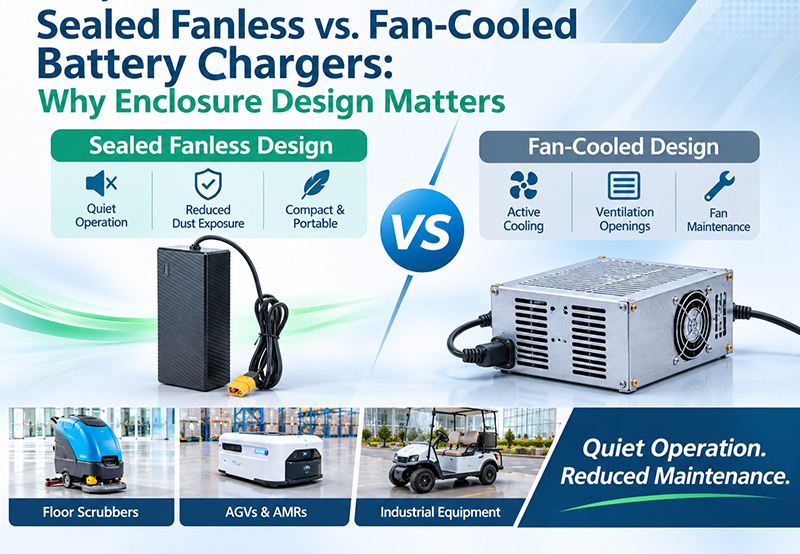
Why Enclosure Design Matters?
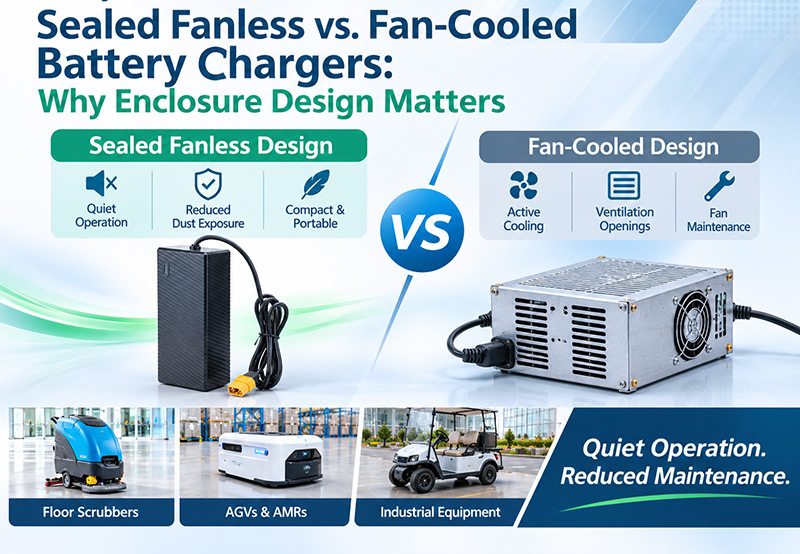
The charger's enclosure and cooling architecture can have a significant impact on its reliability, maintenance requirements, operating environment and overall user experience. When choosing a battery charger for industrial equipment, robotics, floor scrubbers or electric mobility systems, output voltage and charging current are only part of the equation.
Two common approaches are sealed fanless chargers and conventional fan-cooled chargers. The latter typically use metal or plastic housings with ventilation openings and an internal cooling fan, while sealed fanless designs rely on engineered heat transfer and natural convection without forced airflow.
Neither approach is universally better. The right choice depends on power dissipation, operating temperature, installation conditions and environmental requirements.
However, for applications where portability, low noise, reduced exposure to airborne contaminants and simplified maintenance are important, a properly engineered sealed fanless charger can offer meaningful advantages.
Henryuan 24V 10A LiFePO4 battery charger provides a practical example of this design approach.
1. Two Different Cooling Architectures
Before comparing the advantages and limitations, it is important to understand how these two charger designs manage heat.
Sealed Fanless Charger: Natural Convection Without Forced Airflow
A sealed fanless charger does not depend on an internal fan to circulate outside air through the enclosure. Instead, heat generated by the power-conversion components is transferred through the internal thermal structure and enclosure, then released to the surrounding environment through natural convection and thermal radiation.
The design challenge is to create an effective thermal path from heat-generating components to the external enclosure while keeping component temperatures within their specified operating limits.
A well-engineered fanless charger therefore requires careful consideration of:
- Power-conversion efficiency and internal heat generation
- Component placement and PCB thermal layout
- Thermal conduction paths and interface materials
- Enclosure geometry and available heat-dissipation surface
- Ambient temperature and installation orientation
- Continuous-load performance and thermal validation
This is particularly useful in warehouses, industrial workshops, cleaning equipment and other environments where airborne contamination is a concern.
Fan-Cooled Charger: Forced-Air Thermal Management
A conventional fan-cooled charger uses an internal fan to move air through ventilation openings. The airflow carries heat away from internal components and heat sinks, helping maintain acceptable operating temperatures.
This approach can provide a higher heat-transfer rate than natural convection under comparable conditions, making forced-air cooling useful for designs with high internal heat loads or limited enclosure space.
However, it introduces additional design and maintenance considerations:
- The cooling fan is an additional electromechanical component.
- Dust and debris can accumulate on fan blades, filters and internal heat sinks.
- Restricted airflow can reduce cooling effectiveness.
- Fan noise may be undesirable in noise-sensitive environments.
- Fan wear or failure can affect thermal performance.
- Ventilation openings provide potential paths for external contaminants to enter.
A fan-cooled charger is not inherently unreliable. With appropriate fan selection, airflow management, filtration and maintenance, it can be an effective solution. The important consideration is whether forced airflow is necessary for the intended power level and operating environment.
2. Sealed Fanless vs. Fan-Cooled: A Technical Comparison
The following comparison highlights the practical differences between the two architectures.
|
Design consideration |
Sealed fanless charger |
Fan-cooled charger |
|---|---|---|
|
Cooling method |
Natural convection and thermal radiation |
Forced-air cooling |
|
Moving parts |
No cooling fan |
Internal cooling fan |
|
Airborne dust exposure |
Reduced direct ingress through ventilation openings |
Air enters through ventilation paths |
|
Operating noise |
No cooling-fan noise |
Fan noise during operation |
|
Maintenance |
No fan cleaning or replacement |
Fan and ventilation maintenance may be required |
|
Thermal capacity |
Depends heavily on thermal design and available surface area |
Forced airflow can support higher heat removal |
|
Enclosure design |
Can use a more enclosed structure |
Requires airflow paths and ventilation openings |
|
Portability |
Well suited to compact portable designs |
Depends on enclosure size, fan and overall construction |
|
Typical design priorities |
Environmental isolation, quiet operation and reduced maintenance |
Higher heat-transfer capability and compact thermal packaging |
What matters is the complete thermal architecture, including the internal heat-transfer path, enclosure design and operating conditions.
3. Why a Sealed Design Can Be Valuable in Industrial Environments
For many industrial applications, the charger is not operated in a clean laboratory environment.
It may be placed in a warehouse, carried between workstations, used near cleaning equipment or stored alongside battery-powered machinery.
Under these conditions, enclosure design becomes more than an aesthetic consideration.
Reduced Exposure to Dust and Debris
A fan-cooled charger needs an airflow path. As the fan draws air into the enclosure, airborne dust and other particles may enter and accumulate around internal components.
Over time, contamination can restrict airflow, reduce heat-transfer effectiveness and increase maintenance requirements.
A properly sealed fanless enclosure avoids the need for continuous intake airflow. By eliminating ventilation openings for a cooling fan, it helps reduce direct exposure of internal electronics to dust and debris.
This can be particularly beneficial for:
- Industrial floor scrubbers and cleaning equipment
- Warehouse AGVs and autonomous mobile robots
- Portable industrial machinery
- Battery-powered material-handling equipment
- Equipment operating in dusty workshops
It is important to distinguish a sealed enclosure from a waterproof enclosure. Unless a specific IP rating has been tested and documented, a sealed charger should not automatically be considered suitable for immersion, water jets or unrestricted outdoor exposure.
No Cooling-Fan Noise
In environments where equipment operators work close to the charger, fan noise can be an unnecessary distraction.
A fanless design eliminates noise generated by the cooling fan, making it suitable for quieter workplaces, indoor charging stations and applications where acoustic comfort matters.
Fewer Mechanical Components
A cooling fan has moving parts and a finite service life. Its performance can also be affected by dust accumulation, bearing wear and operating temperature.
Removing the fan eliminates this particular failure and maintenance mechanism.
It does not mean that the charger has no components subject to aging or failure. Power semiconductors, capacitors, connectors and other electronic components still require proper electrical and thermal design.
The reliability advantage comes from reducing the number of mechanical dependencies while ensuring that the remaining thermal system is adequately engineered.
4. Thermal Management: Why Fanless Does Not Mean Heat-Free
One of the most common misconceptions about fanless chargers is that eliminating the fan automatically improves thermal performance.
That is not how power electronics work.
Every AC-DC charger generates some heat during energy conversion. The amount depends on output power, conversion efficiency and operating conditions.
Consider a 29.2V 10A charger delivering 292W.
Its output power is:
29.2V × 10A = 292W
The relationship between efficiency and heat generation can be expressed as:
Power loss = Output power × (1 / Efficiency − 1)
For illustration, at 94% conversion efficiency, a 292W charger would generate approximately 18.6W of internal power loss under that operating condition.
This is an illustrative calculation, not a published efficiency measurement for Henryuan's HRY29210000.
The thermal design must provide a path for this heat to leave the enclosure without exceeding the temperature limits of critical components.
The Thermal Path Matters
In a fanless design, heat management involves several connected stages:
Power Components → Thermal Interface → Internal Heat-Transfer Structure → Enclosure → Ambient Environment
If any part of this path is poorly designed, heat can accumulate inside the charger.
For this reason, thermal validation should consider:
- Maximum continuous charging load
- High ambient-temperature operation
- Component hot spots
- Enclosure surface temperature
- Internal temperature distribution
- Different installation orientations
- Long-duration aging and operating tests
5. Which Applications Benefit Most from a Sealed Fanless Charger?
A sealed fanless design is particularly attractive when the charger is exposed to dust, requires frequent handling or operates close to people.
Industrial Floor Scrubbers and Cleaning Machines
Floor-cleaning equipment often operates in environments where dust, cleaning residues and airborne particles are present.
A sealed charger design helps reduce direct exposure of internal electronics to these contaminants, while fanless operation eliminates cooling-fan maintenance.
AGVs and Autonomous Mobile Robots
Warehouse robots and AGVs often operate on repetitive charging schedules.
A compact charger with no cooling fan can simplify handling and reduce one potential maintenance point, particularly where charging equipment is used in shared indoor environments.
Electric Marine Equipment
Portable electric marine equipment can be exposed to humid environments and salt-containing air.
A sealed enclosure can help reduce direct exposure to airborne contaminants, but marine suitability still depends on the actual enclosure sealing, connector protection, corrosion resistance and applicable IP testing.
A sealed charger should not be assumed waterproof without documented testing.
Portable Industrial Equipment
For portable battery-powered machinery, a compact charger without a cooling fan can offer a quieter and simpler charging accessory.
Its reduced number of moving parts can also be useful where equipment is transported frequently.
Conclusion: Choose the Cooling Architecture That Fits the Application
A fan-cooled charger and a sealed fanless charger solve the same fundamental problem—removing heat generated during power conversion—but they approach it differently.
Fan-cooled designs offer the advantages of forced airflow and can be suitable for applications with demanding thermal loads. Sealed fanless designs eliminate cooling-fan noise and reduce direct exposure to airborne contaminants through ventilation openings, while removing one mechanical component that may require maintenance.
For applications such as industrial floor scrubbers, warehouse robots, portable equipment and selected marine systems, a properly engineered sealed fanless charger can provide an attractive combination of compact size, quiet operation and reduced maintenance requirements.
The best charger is not necessarily the one with the largest fan or the heaviest metal enclosure. It is the one whose electrical, thermal and mechanical design is matched to the real operating environment.


 Mail inquiry